Local governments shape much of the day-to-day experience of living in a community, yet many residents are unsure how municipalities work, who makes decisions, or why certain processes take time. Understanding what a municipality does, will provide you with a clear, practical overview of how services are delivered, and how local decisions are made. By understanding the roles, responsibilities, and limits of municipal government, residents are better equipped to navigate services, engage respectfully, and participate in building a strong, thriving community. Municipal government decisions about community amenities such as facilities, roads, water systems, parks, and emergency services determine property taxes, service levels, and long-term community well-being.
Governance and Decision-Making
More than 800 dedicated City employees bring the mission of Making Kamloops Shine to life every day. Guided by strategic direction from Council, these professionals deliver essential services, maintain and build critical infrastructure, foster sustainable growth, and work to enhance community well-being.
The City delivers many essential services, including:
- treating and pumping clean drinking water
- collecting waste, recycling, and organics
- painting road markings and fixing potholes
- managing capital projects
- maintaining parks, public lands, and cemetery operations
- ensuring the safe and efficient operation of our arenas and buildings
- delivering recreation and cultural services
- coordinating and supporting tournaments and special events
- bylaw enforcement, crime prevention, and peace officer services
- providing personnel for administrative support to the RCMP
- firefighting services and wildfire resiliency planning and education
- coordinating and facilitating emergency support services and the emergency operations centre
- addressing community social issues through stewardship, facilitation, communication, investment, and advocacy
- setting policy and planning for development, conducting inspections, and issuing permits
- planning and design for City infrastructure and transportation
- providing direct services to Council and the public through the coordination and recording of Council Meetings and Public Hearings, including agendas, minutes, bylaws, and other records
- conducting elections, referendums (assent voting), and alternative approval processes
- City budgeting and property taxation, and
- managing financial operations, information technology, human resources, risk, privacy, and administration like any other large corporate entity.
Here is a more detailed listing of the services managed by our different levels of government.
Council acts as the municipality’s governing body, while the day-to-day administration and implementation of Council decisions are carried out by a professional municipal administration led by the Chief Administrative Officer—the only staff member who reports directly to Council.
The Administrative team that leads City staff includes the Chief Administrative Officer and seven departmental directors:
- Development, Engineering, and Sustainability Director
- Corporate Services Director
- Community and Culture Director
- Communications and Strategic Partnerships Director
- Civic Operations Director
- Employee Services Director
- Protective Services Director
British Columbia’s Community Charter is provincial legislation that establishes the legal framework for how municipalities operate. The Community Charter defines municipal purposes and powers, including authority over services, bylaws, property taxation, financial management, and emergency powers. The federal government, the province, regional districts, and municipalities each have their own jurisdictions and responsibilities. Health care, social services, education, and the justice system are all examples of local services that are NOT funded and managed by the City.
It is the responsibility of the City to maintain most local streets, but highways and many of our bridges (including the former Red Bridge) are owned and maintained by the Province. Here is a more detailed listing of the services managed by our different levels of government.
Within the authority that the City has been granted, Council sets the City’s strategic direction and approves service levels for everything from the frequency of sport field mowing to the frequency of testing at the water treatment facility. While decisions are made by Council, they are shaped by recommendations from Administration and by public opinion. Our city’s unique climate and topography, demographics and culture, economy and regional context all influence service priorities as Council balances its budget and defines the five-year financial plan to fund programs, services, and capital projects.
Council passed amendments to the Council Code of Conduct Bylaw in 2023 to better manage the costs associated with complaints and investigations, and to ensure the Bylaw is not used for unintended or improper purposes. An independent investigator must be retained to investigate all filed Code of Conduct complaints, no matter the strength of the case. As these investigations are both time-consuming and expensive, having submissions open to the public was causing misuse at great cost to the City, and ultimately, the taxpayer.
The Bylaw now requires Code of Conduct complainants to be City staff or Council members and provides a procedure for addressing complaints that may be frivolous, vexatious, not made in good faith, or not made with respect to a breach of the Bylaw. This Bylaw aligns with many other local governments in BC that do not have a dedicated Integrity Commissioner.
Budgeting, Finance, and Property Taxes
Each year, Council approves an annual budget and five-year forecast for City operations to provide an expectation of current and future years taxation and utility rates. The process starts with City staff who crunch a lot of numbers and conduct research to forecast how much it would cost to continue operating at the status quo. This is called the Provisional Budget.
This analysis considers external and internal factors that will impact current operating costs, both up and done, and identifies new services or projects coming up in the financial plan (or other initiatives with cost implications that have been approved by Council since the financial plan was last updated).
Certain costs are out of the City’s control, yet they still impact the City’s budget, like the fluctuating cost of services like liability and vehicle insurance and electricity. Anticipated changes to revenue streams are also factored in. These can be caused by several factors including population growth and development, scheduled fee changes, changes to usage rates, or changes to external funding streams.
Around the same time that the Provisional Budget is being drafted, there is also an opportunity for both staff and members of the public to pull together supplementary business cases for new projects or service level changes for Council’s consideration.
Staff presents the provisional budget and new five-year financial plan to Council towards the end of the year indicating the projected tax revenue required to maintain the status quo.
Council considers the Provisional Budget and supplementary business cases and decides if the tax requirement is justifiable. Public engagement is sought for input, especially on new business cases put forward by staff and community.
Municipal budgeting requires difficult trade-offs. The City must balance aging infrastructure, increased service expectations, climate-related costs, and limited revenue sources—all while keeping taxes affordable. Decisions often involve weighing immediate needs against long-term community benefits.
Municipalities in BC must deliver a balanced budget and cannot run a deficit, meaning they cannot plan to spend more than they earn for operating costs, this condition is required for all city operations.
If Council wants to aim for a lower tax requirement, they direct staff to present options to change service levels, cut or delay projects, use reserves, or recommend other efficiencies. Estimates within the Provisional Budget are typically conservative and preliminary, leading to natural reductions in the tax requirement as detailed data becomes available.
Council votes to pass the final budget in the spring every year, property tax notices go out in May, and property taxes are due early in July.
The City’s financial plan is divided into two major components: operating budgets and capital budgets. Understanding the difference helps residents see how tax dollars are used and why some decisions cannot simply be shifted from one area to another. While both budgets are approved by Council, operating and capital funds are not interchangeable.
Capital budget = building and improving things
Operating budget = running and maintaining things
Just like homeowners, the City has different types of expenses that it needs to manage.
Operating expenses are the regular recurring costs of keeping the lights on, similar to monthly household expenses, gas in the car, heating the house and food on the table. Operating budgets are developed for Council approval for property taxations, water utility, sanitary sewer utility, and garbage, recycling and organics treatment.
For the City, examples of operating expenses include maintaining fire trucks so they can respond to emergencies, buying supplies to keep our parks beautiful, treating water to ensure it is safe to drink, and paying wages to our equipment operators so that they can collect our garbage and recycling and keep our community clean. Municipalities in BC are not allowed to run a deficit or borrow to cover the costs of operational expenses. The City must plan to cover these costs each year through a balanced budget.
While an operational budget can be calculated annually with mostly short-term impacts, a capital budget looks at a series of projects that can each span multiple years and are planned years in advance.
Capital expenses are more like the money you would spend to add a significant investment in your house, replace your roof or an addition to your house. They are big one-time projects. Consider them investments in the future with lasting results. City capital budget items include replacing or constructing new civic buildings and recreational facilities, road, bridge, sidewalk and trail infrastructure, along with water or sewer infrastructure. The construction of the Kamloops Centre for the Arts and other Build Kamloops initiatives are great examples.
Capital projects are often funded through various sources including combinations of property taxations, utility levies, reserves, and/or grants with complex budgeting including debt servicing.
Property assessments do not have as much impact on tax rates as many people think. The total amount that a property increases or decreases in value is irrelevant. What is important to note is the average increase or decrease across the whole City and how your assessment compares:
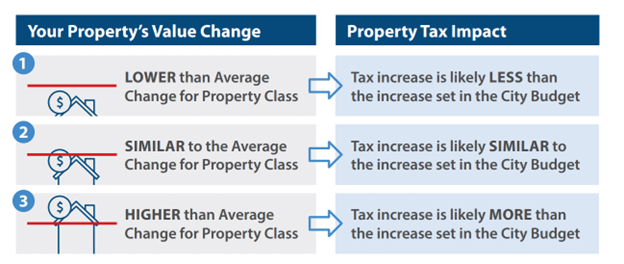
A number of factors outside of the City’s control could influence the annual increase in costs to maintain the status quo for public services, including:
- inflation and rising costs
- aging infrastructure that needs replacement
- community growth and expanded service demands
- new responsibilities downloaded from higher levels of government
- emergencies such as storms, floods, or wildfires
Your final tax bill depends on several factors:
- the total tax funding requirement approved in the City budget
- the total value of your home
- how much that value increased or decreased this year in relation to the city average
- increases or decreases in the tax requirements from the school district, regional district, hospital district, and a few other authorities that also collect through property taxes.
Even though it is the City that collects your taxes, the only portion the City controls is the City budget. Of your annual property taxation payment, approximately 66% is directed to the City, the remainder are collected by the City and immediately paid out to the school district and other collecting authorities.
The City separates water, sewer, and solid waste from the rest of its operational and capital budgets because these utility services are run more like self-contained businesses than general government services. Utilities are paid for by rates/fees charged to users (your utility bill) and are not paid for through property taxes.
The City’s water, wastewater system and landfill management must meet strict provincial regulations for safety, environmental protection, and long-term sustainability. Utility fees ensure these systems remain reliable and properly maintained.
The utility budget is designed to cover all operating costs (maintenance, staffing) while also maintaining sufficient reserves to fund capital infrastructure upgrades and replacement of pipes and treatment plants (capital costs). Having a separate budget for utilities helps the City transparently track where the money is coming from and how it’s being spent while maintaining stable rate increases over time.
In 2025, Council adopted new water and sewer rate structures with variable charges that incentivize water conservation and give homeowners more control over their utility bills by controlling their water consumption.
Understanding your utility bill becomes easier when you know why charges are structured the way they are. The City’s water systems must be built, maintained, and ready to always serve the community—even when little or no water is being used.
Most City utility bills include two types of charges:
- Fixed charges help pay for the availability of water services. This includes the pipes, treatment facilities, pumps, testing, staffing, and emergency readiness required to ensure safe, reliable service is always available to your property.
- Variable charges are based on how much water you use and encourage conservation and responsible use.
Planning and Long-Term Strategy
Communities grow through intentional planning, not by accident. Planning decisions determine where homes, parks, and businesses go, how neighbourhoods look and feel, and what infrastructure is needed to support growth.
The City uses planning tools such as zoning, community plans, engineering standards, and environmental rules to ensure growth is safe, legal, and sustainable. These tools guide how land can be used and what development must include. The City’s Official Community Plan (KAMPLAN) is the guiding document that all other long-term plans align to.
With an elected governing body that changes every four years, strategic direction cycles and fluctuates. Still, longer-term planning is essential, which is one of the reasons why a healthy democratic government involves non-elected public servants providing stability and expertise in long-term planning.
The City is responsible for managing billions of dollars in public infrastructure, such as roads, bridges, water systems, buildings, and recreation facilities. Asset management is the process of planning for the maintenance, repair, and replacement of these assets over their full life cycle. This long-term planning is why municipalities maintain reserves for future repairs and replacements, even when assets may appear to be working today.
Long term planning at the City involves extensive public engagement and public input so that Council and residents can have confidence in the long-term mandate they provide.
The financial plan is updated annually and projects five years out with considerable detail. These projections are based on the objectives of a series of major longer-term plans that have been developed and updated over time including:
- KAMPLAN: the City’s Official Community Plan (OCP), which is a long-term planning document that provides direction on planning, land use, and development in the city to support a projected population of 134,000 by 2045 while setting the stage for longer-term growth.
- Transportation Master Plan: a guide for the planning, design, development, and long-term maintenance of transportation facilities and infrastructure.
- Recreation Master Plan: a strategic document to guide the provision of recreation services in Kamloops and help inform future decision making and resource allocation.
- Parks Master Plan: a framework for decisions related to parkland, park development, outdoor recreation, and park management to ensure that parks continue to address evolving community needs.
- Community Climate Action Plan (CCAP): sets a course for reducing community emissions by 80% by 2050 while increasing our resilience to the impacts of climate change.
- Cultural Strategic Plan: a 10-year vision for Kamloops’ cultural sector and creative communities.
- Downtown Plan: a neighbourhood-level guide to decisions related to planning and land use management for the Downtown, Sagebrush, and West End neighbourhoods.
The City has many other long-term plans in place on topics including accessibility and inclusion, extreme heat response, food and urban agriculture, integrated stormwater management, intersection safety, liquid waste management, urban forest management, water conservation, and community wildfire resiliency.
The City’s website has a searchable directory of the City’s past and current strategies and plans. The City is also constantly updating plans with regular opportunities for engagement.
Access to Information
In BC, the Freedom of Information and Protection of Privacy Act (FIPPA) provides public sector organizations with direction on balancing the following principles:
- Freedom of Information – Whenever possible, information held by the City of Kamloops should be available to the public.
- Protection of Privacy – The City of Kamloops should not improperly collect or disclose personal information.
There are two ways to request information from the City. The first is to make an informal request. Since almost all of the City's information is available through routine channels, you should always start by making an informal request to the department that you feel has jurisdiction or by calling the City's central switchboard at 250-828-3311.
The second way to request information is to make a Freedom of Information (FOI) request. FOI requests are intended to be an avenue of last resort. You should only make an FOI request when the information is not available through routine channels.
FOI requests must be made in writing and may cost processing fees. The City’s website contains detailed instructions on making an FOI request with tips to reduce fees and target the scope of your search for information.
Bylaws and Enforcement
Bylaws are laws passed by Council that only apply within the City of Kamloops. They are local rules for local issues and can touch on a range of topics from zoning and land use to waste collection, noise restrictions, and parking. City bylaws must comply with provincial legislation.
Bylaws can be created, amended, replaced, or repealed (cancelled) by Council during regular Council meetings. All bylaws must receive three “readings” before being adopted, which typically occurs at two separate meetings. Depending on the type of bylaw, statutory notice and a public hearing or public submission opportunity may also be required before a formal vote.
Understanding how bylaws work helps residents know:
- what the rules are
- why the City enforces them
- how to raise concerns or request changes
- what to expect if a bylaw complaint is made
Clear understanding builds respectful engagement and helps the community function fairly for everyone. Most of the City’s active bylaws can be found within the document library on our Council Access Portal. Residents can search the directory using keywords to help find bylaws that may be applicable to a variety of situations.
The City’s Protective Services Department includes a Community Services Division which manages crime prevention, bylaw enforcement, and support services. The City's Community Services Officers were delegated Peace Officer status in 2025, enhancing the tools and protections available to them for bylaw enforcement.
The core authorities provided to the City’s fully accredited Community Services Officers under the Delegation of Bylaw Enforcement Authority Bylaw include:
- issuing bylaw notices
- laying and serving municipal ticket information
- laying information and serving summons under the Offence Act
- executing search warrants in relation to bylaw offences
- entering on or into property
- requesting identification for the purpose of investigating or enforcing bylaws
- seizing, possessing, or transporting personal property and animals, where authorized by bylaw, statute, or court order
- exercising all other powers, duties, and authorities granted by bylaw
The City and its enforcement officers are only able to directly enforce City bylaws. Local RCMP, which report directly to the federal government, are responsible for enforcing all other laws. While RCMP authority and reporting channels are clear, there are also open channels of communication between the City and the local RCMP Superintendent, with regular reporting on RCMP strategic planning and operational outcomes. Council provides input to the RCMP and can act as a voice for residents regarding enforcement concerns.
Reporting Issues and Resident Requests
Residents often ask why the City “can’t just fix” an issue. In many cases, the answer is simple: municipal governments are limited by provincial legislation.
The City must follow legal frameworks designed for fairness, transparency, and accountability. Even when residents disagree with decisions or want quick action, the City cannot act outside its lawful authority. Understanding these limits helps set realistic expectations and strengthens respectful engagement.
Here are common areas where the City has no legal authority:
- overriding provincial or federal laws
- changing property assessments outside the legislated assessment and appeal process
- forcing private developers to build certain types of housing
- stopping development that complies with zoning and planning laws
- controlling police operations or enforcement decisions
- removing elected officials (except in rare provincial processes)
- commenting publicly on human resources/personnel matters
- spending restricted utility reserve funds on other services
- taking sides in civil disputes between neighbours
When unsure which order of government handles an issue, feel free to call the City first — staff can point you in the right direction. Here is a more detailed listing of the services managed by our different levels of government.
Staying Informed
All urgent messages from the City are communicated as alerts or public notices accessible from the homepage of the City’s website. The City has several ways for residents to subscribe to be proactively notified about the information that matters most to them.
Emergency alerts and evacuation notices: Download the VoyentAlert! App and create an account in order to receive applicable emergency notifications including water shutoffs and evacuation notices. During a multi-jurisdictional emergency event that requires an Emergency Operations Centre activation, a dedicated information page will be created that can be accessed from the homepage of the City’s website here.
General City news: Sign up to receive various City newsletters by email here.
Important policy, bylaw, and development-related decisions: Sign up to receive Council Meeting Agendas and Council Highlights via email here. You can also sign up to receive emails regarding all Statutory Public Notices on matters such as public hearings, elections, dispositions of land, and special public meetings.
Feel good news stories: Sign up to receive the City e-newsletter here.
Engagement opportunities: Join our online community by registering an account on Let’sTalkKamloops.ca here. On Let’s Talk, you can subscribe for updates on specific engagement projects. Engagement opportunities will also be shared through news releases or sometimes statutory public notices.
Traffic Updates: Keep tabs on the Kammute page on our website.
For passive information on most of these topics, you can also follow the City on your preferred social media platform:
Follow City of Kamloops – Parks, Recreation & Culture on Facebook for recreation-specific news.